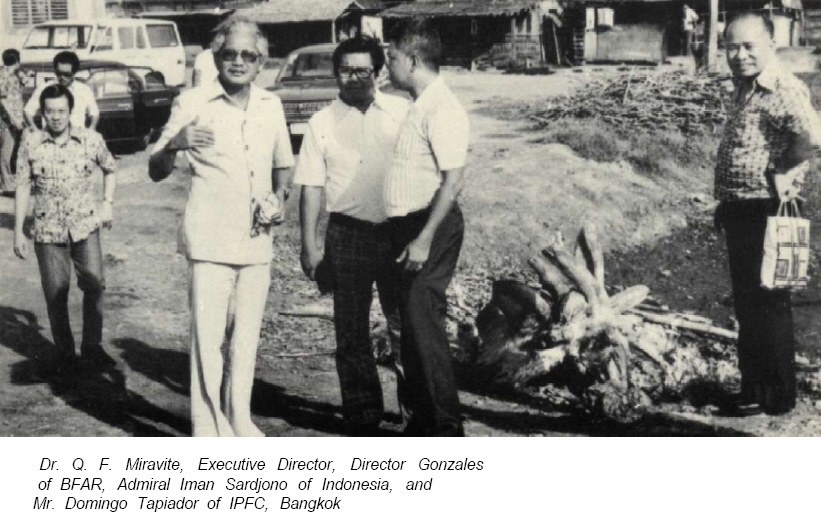
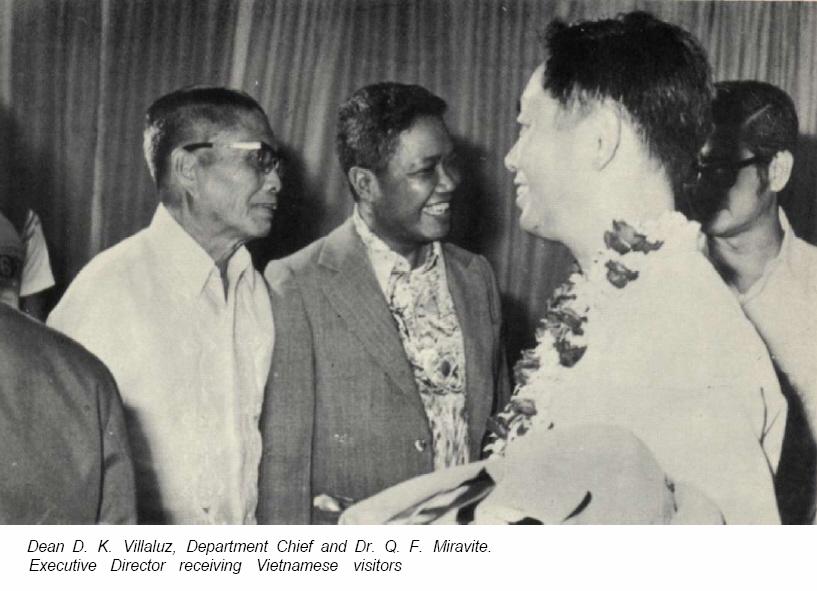
DR. QUITERIO FAJARDO MIRAVITE
SEAFDEC AQD Executive Director/Director for General Affairs in the 1970s.
Born in Cabatuan in 1931. Commencement Speaker of Cabatuan NCHS in 1976.
   One of 12 Miravite Brothers & Sisters who established the Miravite Scholarships at CNCHS during the 1970's and 1980's   
and then adopted/supported AcaoNHS in Brgy. Acao, Cabatuan during the 1990's and 2000's.


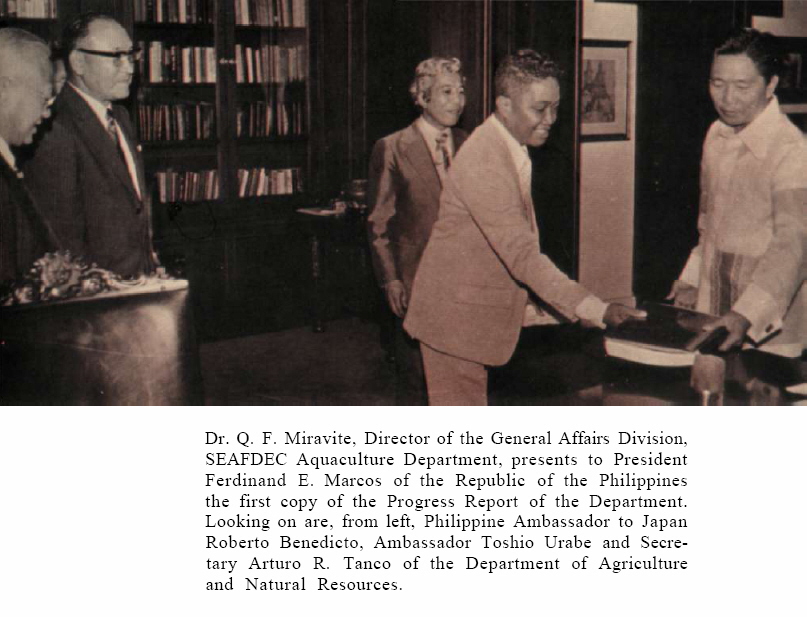
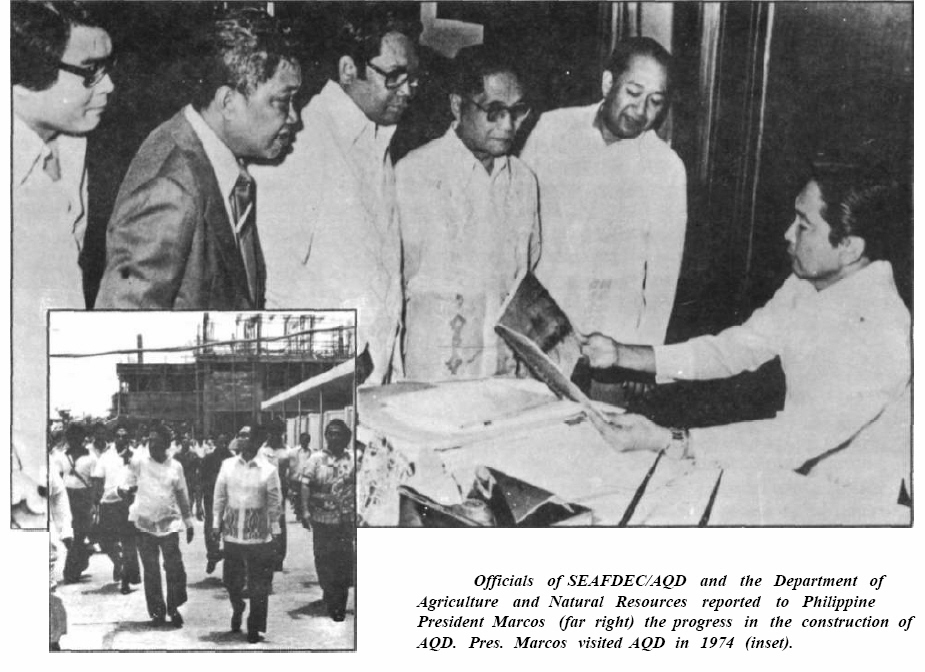
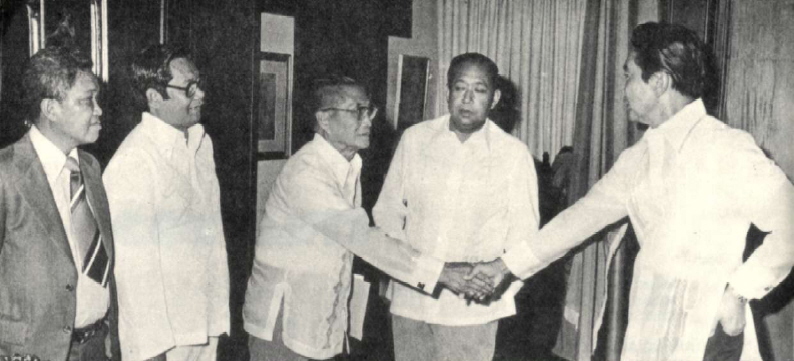
Mindanao State University officials meet with President Marcos re: establishing SEAFDEC AQD in 1973
Dr. Q. F. Miravite is 2nd from left
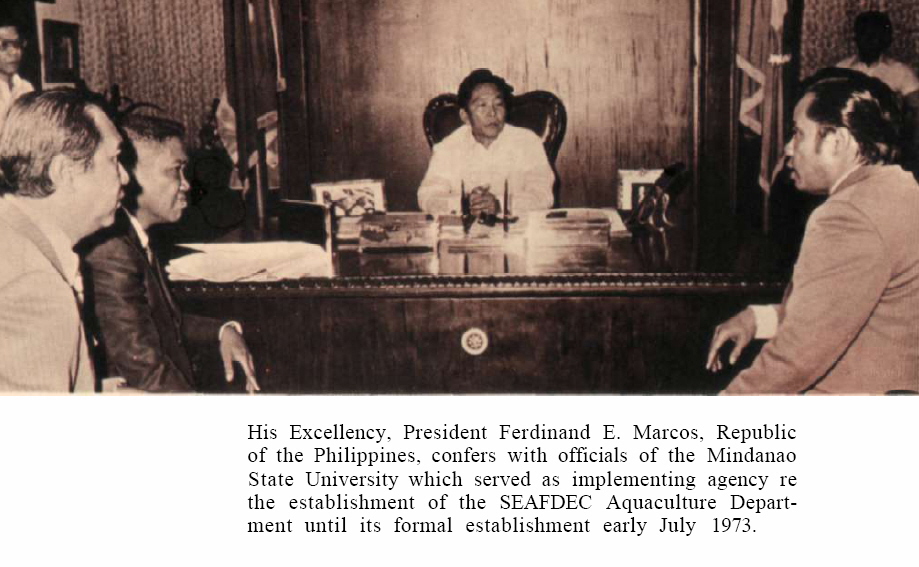

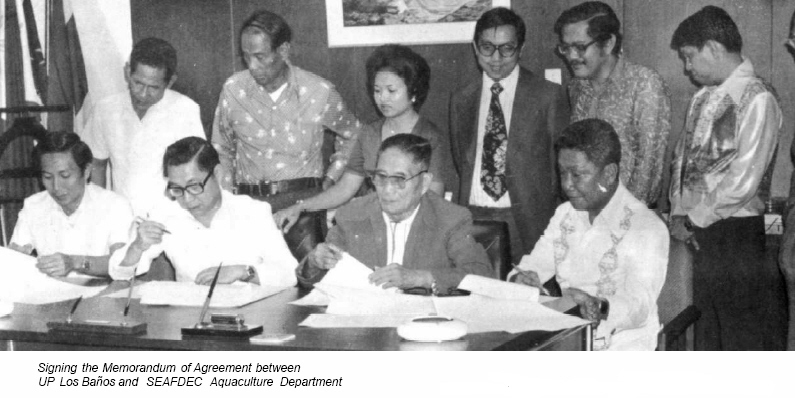
Above Photo: Dr. Miravite is seated second from left, next to the table.   Source: SEAFDEC AQD Annual Report 1973


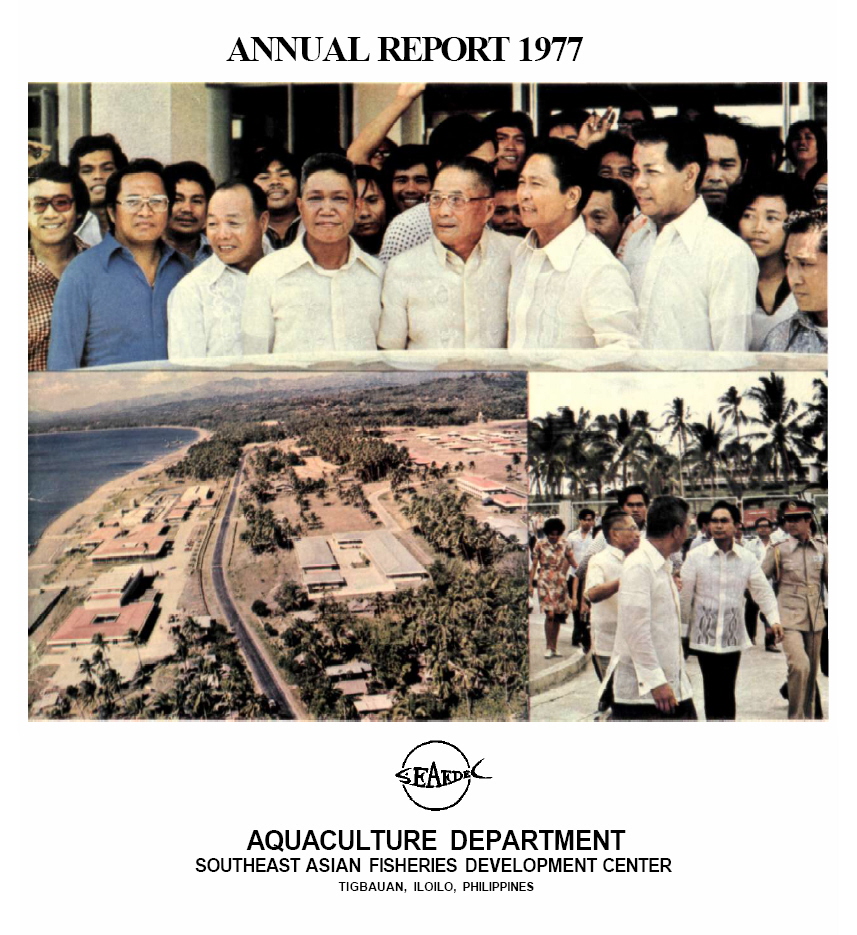
Above: Front cover of SEAFDEC AQD 1977 Annual Report.
(Dr. Miravite is 4th from left in the topmost photo, and in the foreground in the bottom right photo)


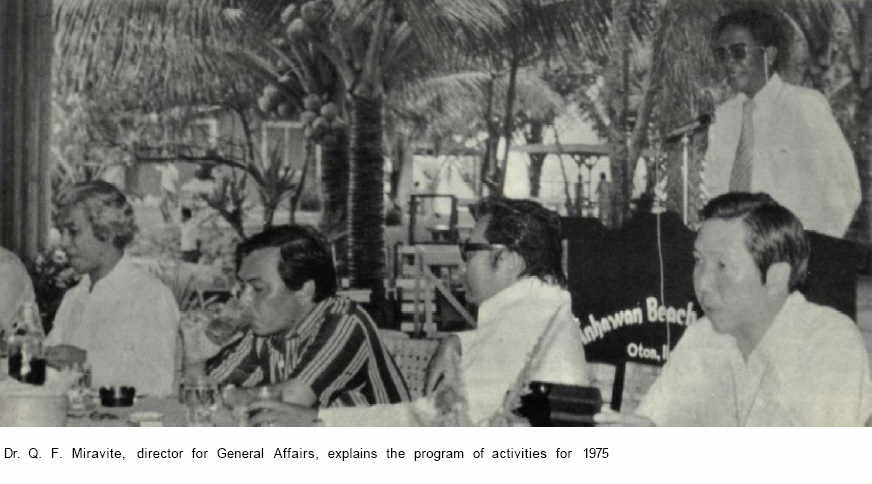
Above Photo: Dr. Miravite is 2nd from right.   Source: SEAFDEC AQD Annual Report 1973


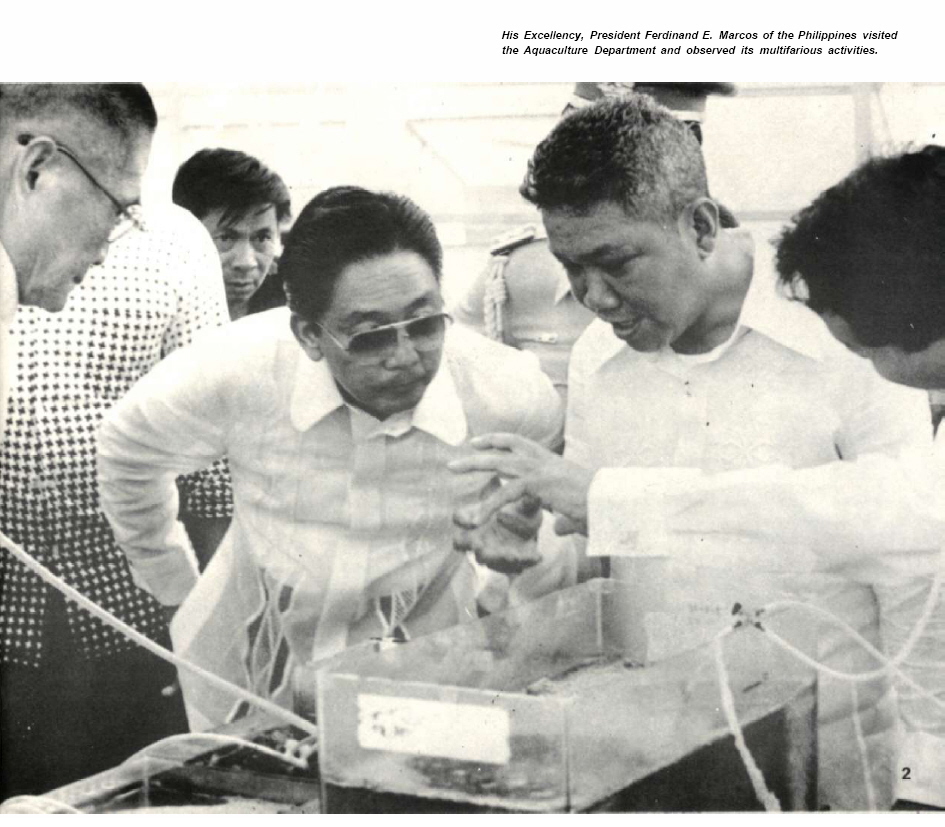
Above Photo: President Marcos and Dr. Miravite.   Source: SEAFDEC AQD Annual Report 1978


Above Photo: Dr. Miravite is third from left.   Source: SEAFDEC AQD Annual Report 1973


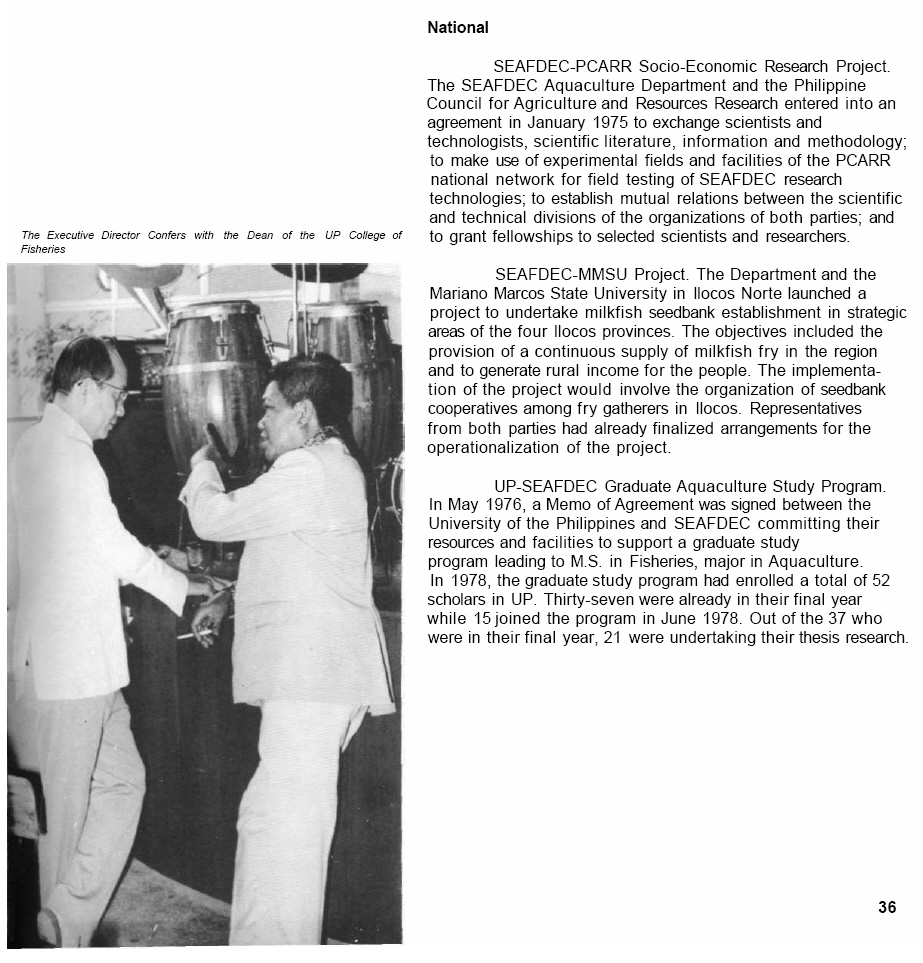
Above Photo: Dr. Miravite is first from left.   Source: SEAFDEC AQD Annual Report 1979


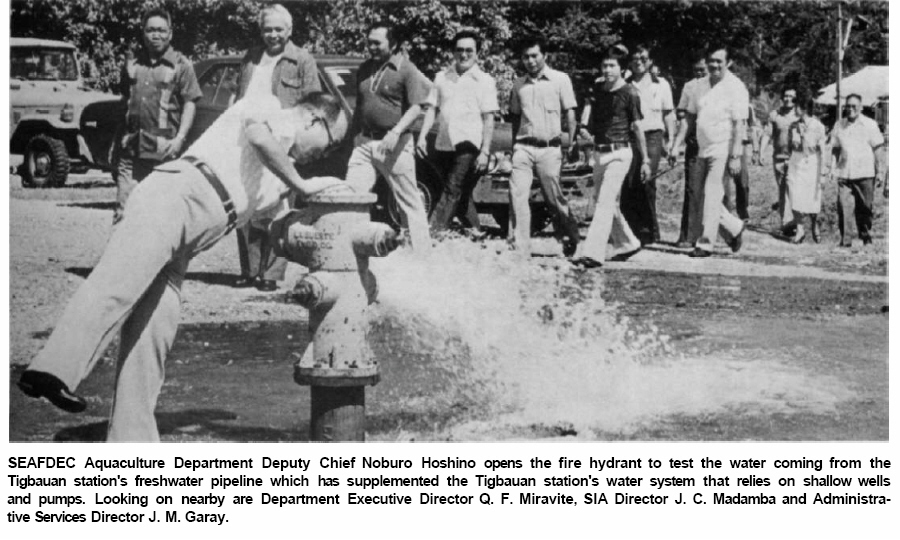
Above: Dr. Miravite is 2nd from left in the main photo.   Source: SEAFDEC AQD "20 Years of Aquaculture: Research & Development"


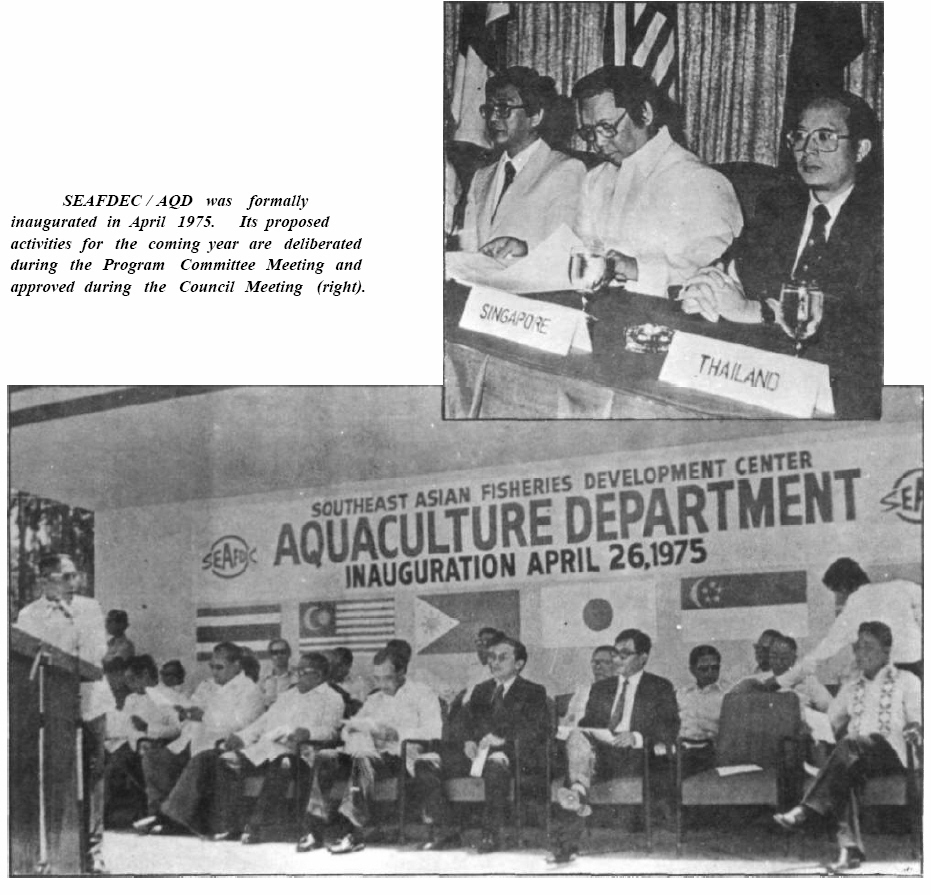
Above: Dr. Miravite is seated at right in the main photo.   Source: SEAFDEC AQD "20 Years of Aquaculture: Research & Development"


Above Photo: Dr. Miravite is at right.   Source: SEAFDEC AQD Annual Report 1978


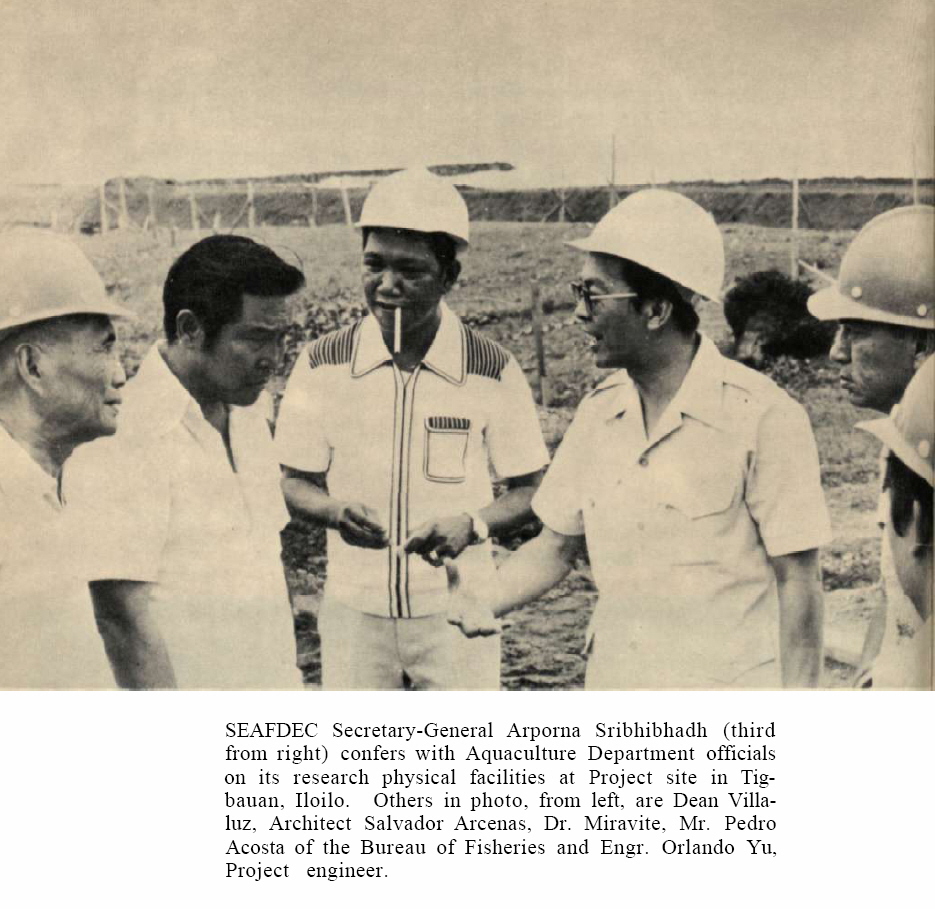
Above Photo: Dr. Miravite is seated at right.   Source: SEAFDEC AQD Annual Report 1977


Above Photo: Dr. Miravite is first from left.   Source: SEAFDEC AQD Annual Report 1977


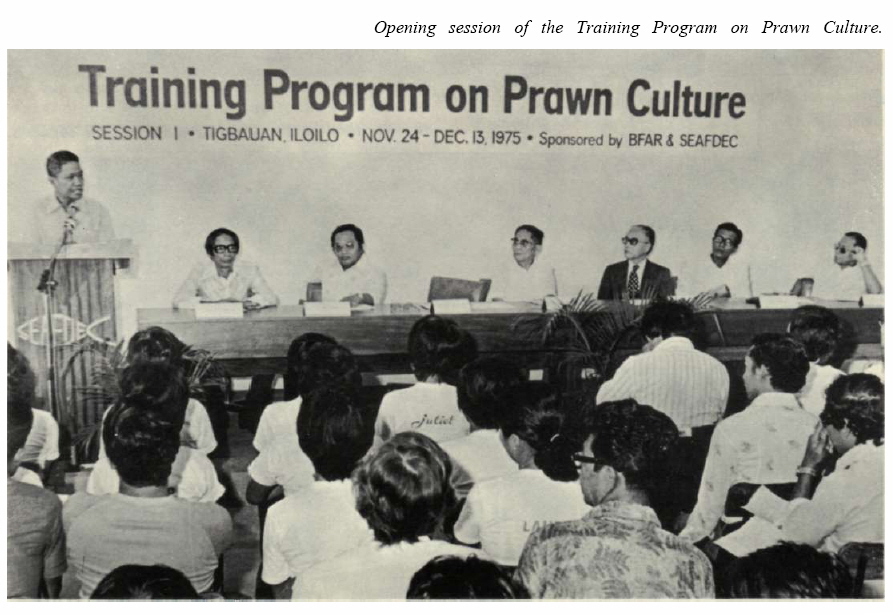
Above Photo: Dr. Miravite is at the podium.   Source: SEAFDEC AQD Annual Report 1975


Source: SEAFDEC AQD Annual Report 1974


Source: SEAFDEC AQD Annual Report 1976


Source: SEAFDEC AQD Annual Report 1976


QUITERIO FAJARDO MIRAVITE
May 23, 1931 - November 25, 1987

     CABATUAN/CNCHS

	One of 12 Miravite Brothers & Sisters who established the
	   Miravite Scholarships in Cabatuan National Comprehensive
	   High School (CNCHS) in the 1970s-1980s

	Commencement Speaker of CNCHS Class 1976,
	   Cabatuan National Comprehensive High School

	Birthplace: Cabatuan, Iloilo

	Both parents are Cabatuananon 
	   Zacarias Continente Miravite (one of 6 Cabatuananon teachers
	      who authorized the town of Cabatuan in 1917 to deduct from
	      their salaries the full tuition of some of their students)
	   Consolacion Legaspi Fajardo (of Brgy. Acao, Cabatuan)

     PERSONAL
	Married to Rosalina Suller, with five children

     EXPERTISE
	Development Planning and Management
	University Planning and Development

     ACADEMIC QUALIFICATIONS
	Ph.D., Visva Bharati State University, West Bengal, India, 1956 
	M.A.,  Manuel L.Quezon University, Manila, 1953
	A.B.,  Manuel L.Quezon University, Manila, 1952   
          
     SPECIAL TRAINING
	Education Planning and Development , 1968
	Indiana University, Bloomington, Indiana, U.S.A. 
	University of Pennsylvania, Midstate, Pennsylvania, U.S.A.

	Development Planning and Management, 1970
	Philippine Executive Academy, 
	University of the Philippines, Quezon City, Philippines
	
     WORK EXPERIENCES
	President, Bio-Resources International, Inc. 1980-87

	Executive Director, Aquaculture Department, 
		Southeast Asian Fisheries Development Center (SEAFDEC)
		Tigbauan, Iloilo, Philippines,  1973-79

	Management Consultant to the Republic of Indonesia
		Planning and development of the Social Security System for Indonesia,
		Jakarta, Indonesia,  1971

	Acting President, Mindanao State University (MSU), Marawi City, Philippines, 1969

	Vice-President for Academic Affairs, MSU, Marawi City,  1968

	Dean, College of Liberal Arts and concurrently Dean, 
		College of Education, MSU, Marawi City, 1965

	Professor, College of Liberal Arts, MSU, Marawi City,  1962

	Barrio Lieutenant, Barrio Ayaman, Cabatuan, Iloilo, 1961

	President, Barrio Lieutenants League of Iloilo, 1961

	Manager, Radio Station #2, National Civil Defense Admdministration, Iloilo City,  1960

	Secretary to the Provincial Board, Province of Iloilo, Iloilo City, 1960

	Editor-in-Chief, Provincial Bulletin (a daily newspaper in Iloilo City), 1960

	Technical Adviser, Office of the Governor, Province of Iloilo,	Iloilo City, 1960

	Editor-in-Chief, Business Gazette ( a monthly publication on Business,
		Finance, Economics and Trade) Manila, 1957

	Managing Editor, Philippine and World Affairs ( a monthly magazine on 
		International Finance, Trade and Geo-Politics), Manila, 1956

	Associate Editor, Industrial Philippines (organ of the Philippine Chamber
		of Industries), Manila, 1956

	Professor of Asian Studies, College of Arts and Sciences, MLQ University,  Manila, 1956

	Foreign News Correspondent, Agence France-Presse Bureau, Manila, 1951

     AWARDS / DISTINCTIONS
	Full Scholarship, Undergraduate and Graduate Studies 
		Manuel L. Quezon University, Manila,  1949-53

	Magna cum laude, A.B., Manuel L. Quezon University, 1952

	PH.D. Scholarship Grant, Government of India Cultural Scholarship Scheme, India,  1954-55

	Ford Foundation Fellow, Educational Planning and Development, U.S.A, 1968

	Distinguish Service Award for contribution to the development of the Mindanao State University 
	from the MSU, Marawi City, 1960

	MSU-UP Grantee, Philippine Executive Academy, University of the Philippines, Quezon City, 1970

	UNDP grantee, Interregional Urban Planning and Development, Warsaw,	Poland,  1973

	Distinguish Service Award for contribution to the development of the Fishpond Industry 
	in the Philippines from the Philippine Federation of Fishfarm Producers, Manila,  1976

	Outstanding Alumnus Award, from the Manuel L. Quezon University Alumni Association, Manila, 1977

     INTERNATIONAL CONFERENCES ATTENDED
	Inter-Regional Urban Planning and Development, United Nations
		Development Program (UNDP), Warsaw, Poland, June 1971

	Regional Adaptive Technology Workshop, East-West Center, Honolulu,
		Hawaii, May 1973

	Majority-Minority Relations in Southeast Asia Workshop, Association of
		Southeast Asian Institutions of Higher Learning, Manila, 1974

	16th Session, Indo-Pacific Fisheries Council Meeting,
		Jakarta, Indonesia, 1974


	Ministerial Conference for the Economic Development of Southeast Asia
		Manila, Philippines, November, 1974

	6th SEAFDEC Council Meeting, Kuala Lumpur, Malaysia, July 1973

	7th SEAFDEC Council Meeting, Manila, Philippines, December 1974

	13th Pacific Science Congress, Vancouver, Canada, August 1975

	8th SEAFDEC Council Meeting, Bangkok, Thailand, December 1975

	FAO Technical Conference on Aquaculture, Kyoto, Japan, May 1976

	1st Interdepartmental Meeting, SEAFDEC Secretariat,
		Manila, Philippines, August 1976

	17th Session, Indo-Pacific Fisheries Council Meeting,
		Colombo, Sri-Lanka, August, 1976

	9th SEAFDEC Council Meeting, Tokyo, Japan, December 1976

	2nd Interdepartmental Meeting, SEAFDEC Secretariat,
		Singapore, October, 1997
	
	10th SEAFDEC Council Meeting, Manila, Philippines, December 1977


DR. QF MIRAVITE, THE MAN AND THE LEGEND

by: William R. Adan
MSU Alumni Association

AB Political Science, Batch 1966
Mindanao State University, Marawi
DR QF MIRAVITE, THE MAN AND THE LEGEND: A CLOSE PERSONAL ENCOUNTER
by: William R. Adan; January 12, 2010
http://thelettertoday.blogspot.com/2010/01/dr-qf-miravite-man-and-legend-close.html

I had a love-hate-love relationship with Dr. QF Miravite.

When I arrived in MSU in 1966, Dr. QFM was already occupied with administrative functions as Vice President for Academic Affairs. He was no longer teaching but gave occasional lectures in civic and social training (CST).

One cold November at around 5 pm, the students in CST D, Current International Issues, were assembled in the gym waiting for their lecturer. It was a little dark in the gym because the busted light bulbs had not been replaced and the fog had also crept inside. Suddenly a dark smoking figure materialized in front of us and, after ascertaining that it was the gathering for CST D, started articulating on the conflict over Kashmir between India and Pakistan, the escalation of the Vietnam War, and the raging dispute between the Philippines and Malaysia over Sabah. The eternally smoking dark man in dark suit was no other than Dr. Quiterio. F. Miravite.

Dr. QFM cut quite an impression on me because of his nonchalant attitude and behavior expressed in the way he talked and bore himself. He wore a crooked smile, which came like a smirk, which put his listeners in quandary as to his seriousness of purpose. QFM was an eloquent speaker but came with a voice that was low and a little raspy probably because of the accretion of nicotine in his throat. He was puffing his cigarette with gusto while lecturing. After a while, the fog and his smoke mixed in what most likely was the first smog we knew that hovered around us for the duration of the one-hour CST session at the campus gym.

The Legend

The Miravites were a legend. Reality and myth intertwined around them. Those ahead of us on campus told us that QFM finished his Ph.D. in esoteric studies in India at age 24 and was an expert in yoga and hypnotism. They said that Rozalina, his adorable wife, the first known political activist in Marawi campus, could not have married him if she were not hypnotized by him. The Miravite couple, accordingly, had at any time a case of beer and coca cola under their matrimonial bed: the beer for smoking QFM and the coke for sweet Rosalina. Ma’am Miravite, her students claimed, would always bring with her two or more bottles of coke to her workplace. Dr. QFM had, accordingly, also a stock of beer in some cabinet of his office. He was intellectually productive, like Edgar Alan Poe, when a little tipsy, said many. That he could think and type very fast, I can vouch for it. I watched him one time typed a special order in a zip. I thought the typewriter would break into pieces when he did it.

The Master Strategist

QFM was a master strategist. His game plan was way ahead of everyone’s thought. The creation of MSU IIigan Institute of Technology (IIT) and MSU Sulu College of Technology and Ocenaography (SCTO), evidently with the blessing of President Antonio Isidro, was his branchild. He had probably foreseen that one day MSU Marawi would slowly lose its momentum for academic excellence because of the growing, pervasive and choking cultural atavism in the area that would eventually warp the vision, mission and goals of the University. At least another campus may rise from the fall, in case. The genius of QFM was manifested in the way he assured the development of the new MSU units by securing them special and reliable sources of funds. Under RA 5363, the MSU IIT was assured an annual allocation of 3 percent of the gross income from all sources of the City of Iligan for its operation and maintenance. On the other hand, MSU SCTO was to receive from the Bureau of Custom 5 percent ad valorem duty on processed imported marine products (RA 6060), collectible every end of each quarter. For whatever reason, either by new legal issuances or as a result of administrative mediocrity, MSU SCTO (now TCTO, where T stands for Tawi-tawi) stopped to receive its valorem funds after the declaration of Martial Law. And the revamp of the MSU Board of Regents after the EDSA I Revolution lost the Iliganon’s representation in the policy making body of the University and, consequently, stopped the flow of the City’s tax money to the coffer of MSU IIT.

At any rate, Dr. QFM managed to divert some funds from the ad valorem money of SCTO to finance the physical development and operational enhancement of a small marine research laboratory of the MSU College of Fisheries in Naawan, Misamis Oriental. The research lab which would be known later as the Institute of Fisheries Research and Development (IFRD), the forerunner of MSU Naawan, eventually became the birthplace of the Sugpo Revolution in the country. MSU Naawan developed the first technology in the mass production of the fry of the tiger shrimp, p. monodon, in hatcheries and their culture in brackish ponds early in the seventies. This feat of MSU Naawan was used by QFM to eventually corner and capture under MSU management the establishment of the Aquaculture Department of the Southeast Asian Fisheries Development Center (SEAFDEC AQD) in Tigbauan, Iloilo. The first wave of research workers of SEAFDEC AQD came mostly from MSU Naawan and partly from Marawi campus. The first Japanese shrimp experts conducted their preliminary production experiments at the MSU Naawan hatcheries. In 1975 when the formal management structure for SEAFDEC AQD was formally approved by its member countries, MSU’s supervision over the Aquaculture Department of SEAFDEC was ended.

Up Close and Personal

But let me backtrack a little. My first personal encounter with QFM occurred some three months after the student demonstration in August 1969 in MSU Marawi. My love for legends started to fade away.

The whole country then was wracked by student activism and the fever rubbed on us at MSU Marawi that gave birth to the Student Reform Movement (SRM). I found myself in the company of Jun Acut, Dan Lobitania, Dave Tauli, Willie Lazaro, and the late Rod Cadiente, Glenn Rosauro and Sammy Marohombsar, among others, in the frontline of the movement. The Marohombsar cousins, Rebecca and Myrna, were among our links to the Girls Dorm I can still remember. The Student Government headed by Abe Alonto joined forces with us.

The SRM led probably the longest campus demonstration and boycott of classes in the whole country at that time that lasted for 9 days, from August 6-15, 1969. It grappled on the issues and concerns that beset the scholars’ paradise: security problems – the increasing frequency of physical assault of boys’ dorm occupants, the slapping contests carried out by non-campus residents, and the thievery on campus; the inadequacy of learning materials, particularly textbooks, where in major courses only one textbook was available for some 15 students despite our textbook allowance; the invariant, almost nauseating meals in the cafeteria; the insufficient water supply whose share for the students flowed to the dorms at 12 midnight or 4 in the morning; and the low quality of health and other student services. Of course in the speeches of some student leaders, corruption in the University and the government were dished out along with the national outcry on American imperialism. I noticed along the way, however, that local campus politics took a ride on the student movement for change. The demand to oust President Isidro and QFM insidiously took the front seat of the struggle and put me in a moral dilemma because I was not personally sold to the idea. I did not believe it was necessary. Tension was mounting. The Board of Regents of the University had to hold a special meeting on campus to listen to the student’ demands and break the stalemate on the negotiation between the University administration and the student leaders in ending the boycott of classes. The Board’s chief negotiator with the students was alumni representative James Claude S. Mante. At the end of the day, President Isidro had to retire outside of schedule. QFM managed to hang on.

It was difficult to go back to study mode after about a month of freedom and disorder in one’s immediate environment. Nonetheless, I managed to pass in all my subjects and maintain my scholarship. When it was time to enroll for the second semester, I got the shock of my life: the faculty in the political science department would no longer admit me. I was given no explanation but was advised to see Atty. Jose Agbayani, the University Registrar. I went to Atty. Agbayani and was told to see Dr. Quiterio F. Miravite, the Vice President for Academic Affairs.

QFM welcomed me in his office with a handshake and his patented smile and said:

“Congratulations William. We have examined your academic records and noticed that you have already met the minimum requirements for graduation. Thus, you don’t have to enroll this semester. We have already considered your candidacy for graduation.”

I was tongue-tied for a moment. I did not expect this development. I felt, however, that I was being robbed of something. I looked at him and said: “Sir, I was able to maintain my scholarship and am still entitled to enroll this semester. There are still a lot of things that I have to learn and I will not be happy to settle with minimums.”

His reaction was immediate and furious. “Gago ka talaga. Kung hindi ka pa naman tanga, eh binibigyan na nga kita ng pabor, ayaw mo pa. Yong iba nga dyan, umiyak-iyak na, halos lumoluhod na para maka-graduate lang. At ikaw pa-ayaw-ayaw pa!”

“Sir,” I tried to reason out, “we have this scholarship contract. You can’t just dismiss it. I have the right to study and stay here for another semester.”

“The contract is subject to certain policies of the University. We have made the decision. If you insist, you can go to court,” he declared.

There was no way for me to go to court. I didn’t even have fare money to go home. At the end of the enrolment period, I went back to the Registrar and asked for development in my favor. There was none. I could not stay on campus and eat free meals without an evidence of registration for that semester. So I went back to QFM and told him that I gave up and that I was going home. But because I did not have fare money, I wanted that my travel, book allowance, and the equivalent monthly stipends for the remaining semester provided for in the scholarship contract be given to me. He agreed and in less than two hours I got my money and went home to Butuan the following day. That was how I was “kicked out” from the University and enjoyed my vacation ahead of the flock courtesy of QFM. Given this free time, I gave no second thought when invited by the junior faculty of MSU led by Yesnoy (formerly Nonoy) Macasantos to join the Movement for Better MSU (MBM). But this is another story that I may tackle in some other time.

The Encounter in Bongao

Two years later (1971), I accepted the invitation of Fred Santiago, then Director of the Sulu College of Technology and Oceanography, to help him in launching the college program in Bongao, Sulu (now Tawi-Tawi). I came to Bongao in the company of Elvira Ynion (who in two years’ time would become my wife), Corazon Uy, the late Gertrudes Licmoan, Alejandra Napil, Capistrano Tejano, Jr, Angelito Vizcara, and the late Artemio Bernardino (Dan and Helen Vicente, Manuel Lam, Ninpha Gayon, and Eldigario Gonzales followed us later). As the construction of the college buildings was still going on, we held classes temporarily at the Bongao MSU Preparatory High School and under the acacia trees. QFM was around in the first week of August 1971 to see the progress of the construction of the school buildings on campus and to serve as our guest speaker for the 2nd Founding Anniversary of SCTO on August 4, 1971. It was at this time that I heard the famous quote: “the center of gravity of MSU is everywhere and its periphery is nowhere.”

He was not in any way surprised to see me in Bongao but asked me some questions.

QFM: What are the courses assigned to you here?

WRA: I am initially hired as Teacher II. I am assigned to teach English and history subjects in fourth year high school.

QFM: You are a political science major. How do you teach English?

WRA: I want to develop my students in writing and public speaking. I have required them to keep a daily journal and I am correcting their works (sentence construction, grammar, tenses, etc.) every weekend. I am planning to come out with a student publication both for high school and college, to start in mimeographed form. To improve their public speaking ability, I have devised a draw-lot method where a student would pick up at random his topic to develop and deliver extemporaneously in 3 minutes.

QFM: Well, that is something. What do you want me to buy to enhance your teaching strategy?

WRA: A new electric mimeo machine for the student publication and a portable tape recorder with a lot of blank tapes and batteries for my public speaking classes (Bongao did not have electricity at that time but we have a generator at the Guest House).

One month later, Dir. Santiago brought with him to Bongao a new Gestetner electric mimeo machine, a portable Sony tape recorder and a Pentax SL camera for me. I immediately organized the editorial staff of the first student publication in SCTO campus, “The Sambatau (for Samal-Badjao-Tausog) Echo” and came out with our first mimeographed maiden issue at no time at all. The tape recorder was still a novelty at that time. My students were amazed and fascinated to hear their voices for the first time and were laughing at their speeches. Their shyness and apprehension gone, they started jockeying thereafter for priority position to talk extemporaneously in class.

The Encounter in Naawan

A year after the declaration of Martial Law, the local talents in Bongao wanted to run SCTO themselves. Fred Santiago returned to MSU Marawi and helped QFM in working for the establishment of SEAFDEC under the wings of MSU. Because I was critical of the way the campus was managed and was strongly identified with Fred Santiago, the new SCTO administration tried to find ways to ease me out of Bongao. One night, the MNLF assaulted Bongao and found ourselves scampering for safety. Jun Tumanda and wife, Farida Alibasa, Dan and Helen Vicente, Letty and her hubby, the late Fruc Escudero and I took refuge in Zamboanga City. When we failed to return to Bongao after two weeks because of the turmoil, the SCTO administrators terminated our employment. With the intervention of Dean Domiciano Villaluz, Pres. Mauyag Tamano reversed the action of SCTO management and facilitated the transfer of Fruc and Letty to the MSU College of Fisheries in Marawi and our (the newly-wed couples, Jun and Faring Tumanda and Willy and Bing Adan) transfer to Naawan as research assistants in May 1973. Dan and Helen Vicente would follow us soon.

In Naawan, Dean DK Villaluz made me his public relations officer and the first head of Training and Extension Program of IFRD. When MSU was finally designated by Malacanang as the implementing arm of the Aquaculture Department of SEAFDEC, Dr. Miravite came over to Naawan and sat with me to discuss a massive technology dissemination program on the culture and production of sugpo in hatchery and fishponds. He suggested that we develop a 3-day fishpond cooperators training program in collaboration with SEAFDEC Iloilo and the Bureau of Fisheries and Aquatic Resources (BFAR). The concept was to train fishpond operators with their caretakers, help them develop or prepare their ponds, and give them 10,000 sugpo fry each gratis to experiment the culture of the same in their respective pond conditions. MSU Naawan researchers would monitor the physical and chemical parameters of the production experiment.

I first balked at the idea because I was quite aware that the technology in sugpo production was still immature and was in fact still a hit-and-miss thing. But it was difficult to stop QFM. You either have to move with his traffic or be pushed aside. I decided to go with him. I personally convinced myself that it would take 5 years or more for the sugpo technology to mature in our laboratories. We took the unorthodox move of involving the users in improving the technology and have this same mature in their own hands. What we did short-circuited the paradigm of existing school of thoughts on technology generation, development, dissemination and adoption. It was a gamble that became the subject of my master’s degree thesis three years later.

The fishpond cooperators program was duplicated later in SEAFDEC when it started operating its shrimp hatcheries. At the conclusion of the program, only about 5 percent of those given sugpo fry to culture in their ponds reported different levels of success. But these successful innovators would soon become the source of improved culture and production technology to the neighboring farmers. Parallel to the pond production effort, we also trained fish farmers and their technicians in the operations of shrimp hatcheries. As a result, shrimp culture became a “sunshine industry” in the country and Southeast for that matter in the late seventies to the nineties.

The Last Encounter

I suppose Dr. QF Miravite was already out of SEAFDEC but ran a consulting firm known as Bio-Resources International (BRI) which was quartered at Zeta Building in Ayala, Makati, when I paid him a visit for a personal purpose sometime in 1983. BRI’s major project at that time was the Vitali Fishpond Estate of the Southern Philippines Development Administration (SPDA). Everyone was busy in the office when I arrived. Nevertheless, Nonoy (now Yesnoy) Macansantos, BRI’s chief of staff, ushered me to the plush office of QFM. Apparently, QFM was in a foul mood that morning. When I requested him for a road-right-of-way through his lot which was adjacent to my lot in Naawan where we were constructing our house, he became unnecessarily abrasive.

QFM: Ano, hihingi ka ng road-right-of way sa akin? Kon di ka pa naman gago, bakit ka bumili ng lupa na walang madadaanan? Ang dunong-dunong mo tapos nagkaroon ka ng problemang ganyan at ipasa mo ngayon sa akin. Sayang ang dunong mo!

WRA: Hindi ko ho alam noong una, Doc, na kailangan yon pagmag-loan ka sa bangko. Akala ko noong araw pwede na yong trail or pathway para sa gawin naming bahay. Babayaran ko naman ho yong road-right-of-way. Hindi ko hinihinging libre.

QFM: Hindi ko problema yon. Nagpakatanga ka, problema mo yan.

WRA: Bakit ka naman galit sa akin? Hindi naman kita pinipilit. Kong ayaw mo di ayaw. Bibili na lang ako ng helicopter pagdating ng araw para makapasok sa lote namin.

I left him without saying goodbye. I bantered for a while with his staff some of whom were familiar to me. When I was about to leave Yesnoy came to me and asked me some details on my request. I showed him the sketch of the lot, the location and the total area of the road-right-of way, and informed him of the prevailing price of land in Naawan. We agreed that I pay double of the prevailing price. I needed 70 square meters and I was to pay P2, 800 in manager’s check for the road-right-of-way. Two days later, I returned to BRI and handed to Yesnoy the manager’s check. He handed to me the road-right-of-way instrument, which was already signed by QFM, together with the land title for annotation purposes.

In a trip to Manila sometime in the second quarter of 1987, or four years after the encounter in Makati, I learned from former SEAFDEC Chief (Jan 1983-April 1986) Dr. Fred Santiago that QFM was sick and was closeted in his condo (Sunset Condominium) in Roxas Blvd. Jun Tumanda was with me at that time and we decided to pay him a visit.

Our arrival in his condo was unannounced. When he opened the door he was so surprised and pleased to see us. He was unnaturally warm in welcoming us. He gave us a hug and immediately offered us a choice of drinks. We settled for orange juice. Apparently, QFM was sorting his papers when we arrived and these were scattered on the table and on the floor. Then he smiled and walked towards the table and pulled out a document and said: “Willy, look, I have still here your manager’s check for the road-right-of-way.” He giggled as he handed me the check stapled on the land title.

That was the last time I saw the real man and the legend I learned to love again.

William R.Adan
AB Political Science, Batch 1966
MSU Marawi

Source: http://thelettertoday.blogspot.com/2010/01/dr-qf-miravite-man-and-legend-close.html


MINDANAO STATE UNIVERSITY - ILIGAN INSTITUTE OF TECHNOLOGY (MSU-ITT)
AT 40 (1968-2008)

by: Christine Godinez-Ortega
Professor, MSU-IIT

Ph.D. in Fine Arts (Creative Writing),
De La Salle University

ILIGAN SCHOOL LIVES UP TO ITS PROMISE
by Christine Godinez-Ortega; July 19, 2008
http://www.msuiit.edu.ph/news/news-detail.php?id=12

IIT at 40

In these times of rice queues and weekly fuel price increases, parents this side of Mindanao need not send their children to study in big cities. They can look to the Mindanao State University-Iligan Institute of Technology (MSU-IIT) as an alternative to affordable quality education.

Celebrating its achievements for the education of Mindanaoans for 40 years was what the excitement was all about during this year's Charter Day of the MSU-IIT last July 12.

The weeklong celebration featured educational, cultural, sports and social events that ended with a motorcade around Iligan, a Charter Day program and the Grand Alumni Homecoming bringing in visitors from here and abroad—a no mean feat for an institute that, in 1968, started with six faculty members who were paid, according to pioneer Melvin Roscom, P6 an hour to teach English, Spanish, Mathematics and the Social Sciences to its first 300 students.

At present, there are 544 faculty members teaching 11,120 scholars and non-scholars, who, on the average pay P200 per academic unit because they are subsidized by the government.

Back channels

In 1968, the IIT, through back channeling and secret maneuverings led by then MSU Vice President for Academic Affairs Quiterio Miravite, with the blessings of the late MSU President Antonio Isidro, integrated the Lanao Technical School in Iligan. On July 12, IIT received its charter through Republic Act No. 5363 becoming the first external and, later, autonomous campus of what would become the MSU system consisting of six campuses at present.

Today, IIT has various imposing buildings spread around 13.917 hectares of land facing east beside the Iligan Bay. Recently, it inaugurated its Bahay Alumni beside the about-to-be completed building for Peace education. IIT's robust development is part of its commitment as it envisions itself to be "a globally competitive institution of higher learning committed to excellence in science and technology for the sustainable development of Southern Philippines. "

Promise

And IIT has lived up to its promise in providing technical manpower for the industries in Mindanao and the rest of the country producing each year, over a thousand graduates in its undergraduate and graduate programs. It has also produced outstanding young scientists among its faculty members in mathematics (1), biology (3), physics (1) and chemical engineering (1).

World-class

Even as IIT highlights science and technology faculty achievers and engineering board passers in every annual report, it does not neglect a holistic nurturing of its students as the institute continues to develop its academic programs, researches, publications, linkages, infrastructure and cultural activities such as the support of its resident cultural troupes, as well as its hosting, in the last 15 years, the Iligan National Writers Workshop, one of only three workshops in the country institutionalized by the National Commission for Culture and the Arts.

All this is geared towards that dream of achieving "world-class" renown in the words of the present Chancellor Marcelo Salazar thus challenging future leaders who must continue to realize the Institute's aspirations such as the acquisition of a modern library and with it, the latest information technology equipment, state of the art science and engineering technology laboratories and more classrooms.

Former IIT Vice President and Department of Education Undersecretary Manaros B. Boransing said it well when he proudly declared that IIT has "maintained its standards" compared to "other educational institutions which have declined in quality at the departure of pioneer leadership."

IIT's pride, indeed, is well-placed for its achievements have been well-earned at 40.

Source: http://www.msuiit.edu.ph/news/news-detail.php?id=12


More on Dr. Q. F. MIRAVITE
FROM: msuans@googlegroups.com
When we entered MSU in 1965 and bunked in the God-forsaken Malayan dorm (with batchmates Camar Umpa, James Mante, Boy Anota, Willie Martizano, UdtogTanday, the late Ver Diesto, Alex Otic, Ramon Barbon, Earl Briones, Moner Bajunaid, Henry Saarenas, Oca Lanciola and others including recently appointed CA justice Lovell Bautista), Dr. Miravite was the Dean of Liberal Arts and Sciences. Before the year ended, he was appointed VP for Academics. Thus, pioneers like Halil were lucky to learn philosophy from a brilliant mind.

Prof. Rizalina was your CST (Civics & Social Training) instructor while she was mine in SEA history. I guess she made an indelible mark in campus history by leading the first anti-American rally in Lanao and possibly Mindanao when Amb. Henry Byroade visited MSU as convocation speaker. We hand-painted slogans on cardboards and strung them around the couple's cottage at her behest. It seemed unthinkable that the family circle was bisected - one half was better and for while the other was bitter and against. Such was their complexity and contradiction. But 'Qui-te" wasn't in other endeavors. He was a paradigm of consistency and ability when it came to executive and academic matters. He scrounged from everywhere and badgered national officials and agencies to provide for the scholastic needs of the university. His was the > mission while Dr. Isidro's was the vision. It was Qui-te who organized IIT and SCTO. It was he too who recruited the first graduates in 1966 to remain and teach at the campus rather than continue to hire from UP. Manong Sarangani, Carolina Macapili, Lyra Blanco, Marlene Deluao, Patoy Torres and Helen Colmenares were among them. Succeeding grads were later persuaded to staff the faculty needs of Iligan and Bonggao campuses. The first batches remember him as that dark indefatigable Ilonggo, almost always in a dark suit, with a warped smile and chain-smoked cheap Ice King cigarets in his left hand and 35-ct San Miguel in his right. You're correct, batchmate. Qui-te was a regular guy but with a boundless heart and an infinite mind.

Sirruffy, Fred Santiago, Ma'am Genne Primavera, Rolly Platon, Jovy Lazaga, Fred Yap and other SEAFDEC MSUans can best attest what he accomplished there. I understand he fended off UP attempts to dominate the research center at the expense of MSU alumni and faculty that he brought along.

Much has been said about Dr. Isidro, little or none at all about the other two of the original Three MSUsketeers (he, Qui-te and Atty. Francisco Macutay, the resourceful VP for Admin.) If I were to liken MSU as a bus, Isidro was the driver taking it to its destination, Macutay was the mechanic keeping it running while Qui-te was the conductor luring passengers and ushering them to their seats. No one wondered why the bus was still full despite it being crafted out of patched wood and shingles, propelled by a rickety engine, with no air-con, little water and spotty lights.

Those were the times, my friend, ages ago when . . . you were sixteen. And now that you turned 61 yesterday, which resto did you use your senior citizen's discount card?

Bobby Lim
January 6, 2010


Hi to Cabatuan Nephew. I belong to Batch '65, College of Engineering. Ma'm Rosalina Miravite was our teacher in CST subjects. I remember Mr. 'Quite' Miravite as a prominent figure in the administration. I was just not certain what position since I was a freshman trying to find his way around that strange place, so far from Bataan. Mrs. Miravite, she always smiles, even her eyes show it. Mr. Quite, my first impression was quite a serious chap. One time our group had to make a report on South East Asian cultural topic. I volunteered to type it though my typing skill was non existent. Father was a Notary Public and he used to type his documents using just two forefingers. I must have tried the keys some time in high school so I must have thought I could do it.

Ma'm Rosalina was kind and encouraging, she let me use the office typewriter. Working at a snail pace I was frustrated. My mind was faster than my fingers. I knew what letter to hit next but my two fingers could not locate it fast enough.Then I sensed Mr. Quite's presence coming from behind. He went to his office and attended to some papers. Later he came out, walked around and hovered. I imagined he would like to use the machine but he did not say a word. He went in and did other things. I thought it was a combination of youthful chutzpah, emboldened by a lady's encouragement (his lady no less) which saw me through that ordeal to finish the task.

Later in Manila I took up typing lessons in Underwood Institute to polish my skills. I am grateful that I did not receive a discouraging remark from Quite which could have adversely affected my studies. Much later, I married a lass from Iloilo and in my recent excursions there I pass by Cabatuan on the way to Tigbaun and Igbaras. Now I have something to remember the place with more intimately.

Thanks for the info.

Apolinario P. Mina
Consultant
ArchEn-Strategic Projects Management
January 4, 2010


Hi, William. You don't really know me. But I read your account of QFM to the last line. It is indeed very poignant. I didn't study at MSU....but taught at IIT in the late 70s. I believe at the that time QFM was already engaged in private consultancy (BRI?). But I get the impression that MSUans of your generation who were at the helm of IIT at the time (Rener Soliva, Naroh Boransing, Yesnoy, etc...)...all held QFM in awe.

I briefly saw Dr. Miravite on campus. This must have been during an IIT Foundation Day. I think he was being awarded for pioneering IIT or something. The one statement I recall he made had something to do with Naroh Boransing: that he was perhaps the only Maranao could look beyond the shores of Lake Lanao.

Given his accomplishments based on your accounting below, QFM was no doubt a visionary. And we all admire visionaries.

Your personal encounter with QFM gave you insights into the many hats he wore, mainly those of being an administrator --or policy strategist, if you will, facets of his complex personality that you perhaps liked least in him. But, in the long run, your viewed him in a different light--you saw the human in him. Nice.

Ricardo Caluen
January 12, 2010


I truly admire this piece too! what a touching and sentimental 'love story'!...Thanks Sir William for bringing us down the memory lanes of MSU...

Annie Babarin-Dorner
Stem Cell Transplantation & Research Lab
Children's Hospital, Univ. of Tuebingen
Germany
January 12, 2010


Me too, I enjoyed reading tidbits about Dr. MIravite. All I remember of him was that he smoked, rarely smiled. Of course, he never knew me nor me of him.....

Perla Fickenscher
January 11, 2010


I enjoyed reading this piece from beginning to end! Thank you for sharing and for giving us the opportunity to know Dr. Miravite up close, and for refreshing our memories with some events in the past..

Medarda Naga
January 11, 2010


Dr. Miravite was like a father to all Palawenos on MSU Marawi campus during the 60s. Without fail, he had been a host to us Palawenos who, by reason of distance, had to remain on campus on Christmas vacations when most students enjoyed the christmas holidays in their respective homes with their families. On my senior year, he was my cold beer drinking buddy at his house almost every other night. He was our wedding Ninong but unable to grace it as he was then abroad. Truly like a father to me .

Lucas Licerio
January 6, 2010


I met Dr. Miravite during my first year in MSU Main but was not under him in any of his subjects. He is a very jolly person and can get easily acquainted with. .my elder brother Manong Sarangani can help you a lot in your querries. .you can get in touch with him in his email ad at datsar@live.com.ph . ..GOD Bless. .

Taha Sarangani
Janury 4, 2010


Hi I am Atty. Halil Ayaon al_rashid Lucman batch 62 , Dr. Miravite was my professor in all my Philosophy subject in MSU . Am 5he first muslim who took up AB major in Philosophy he is guy who seldom laugh and mabait naman sa lahat ng student, mabilis siya kumain, one time I asked him bakit parang hindi niya nagogonya or chew ang food tumawa siya at sabi niya paramagtrabajo kaniyang intestine diba,palagi syang busy dahil after the class punta sya kay Dr. Isidro. On fourth at MSU second semester pinatawag niya sa office ni DR. ISIDRO kinabahan ako akala ko kasi may nagreklamo nanaman laban sa akin ako kasi ang original na bad boy ng MSU ,pagdating doon pinaopo niya at may hawag siyang papel I thought complain yon tapos bilang tumawa ng malakas at sabi congratulation mag graduate ka na pala sobra na units mo, doon lang ako nakahinga ng maluwag thats the guy who does not in public but marunong din pala tumawa yong aking natatandaan sa paboritong kong mentor. MAY ALLAH BLESS HIS SOUL My onlly regrets is that I was able thank him for what he did to me and I owe my being a lawyer dahil he challenges me that made study more,learn more from him

Halil Lucman
January 5, 2010


I dont have any personal memory of Dr. Miravite although after reading the materials that came with this email, I wished I did. He was in MSU when I was there. He must have been a really good man.
Good luck on your project.

Perla Fickenscher
Orange, California
January 2, 2010